
The Toyota Stout release date has become one of the most anticipated topics in the automotive world, with truck enthusiasts and everyday drivers eagerly awaiting the return of this historic nameplate. After more than five decades of absence from American roads, Toyota is preparing to reintroduce the Stout as a modern compact pickup designed to compete directly with the Ford Maverick and Hyundai Santa Cruz. In this comprehensive guide, we’ll explore everything we know about the Toyota Stout release date, specifications, pricing, and what makes this compact truck one of the most exciting automotive launches of 2027.
The History Behind the Toyota Stout Nameplate
Understanding the significance of the Toyota Stout release date requires looking back at the model’s rich heritage. The original Toyota Stout first appeared in 1954 as the Toyopet RK, marking Toyota’s serious entry into the light truck market. This pioneering vehicle established the foundation for Toyota’s legendary reputation in truck manufacturing that would eventually lead to icons like the Hilux, Tacoma, and Tundra.
The Stout nameplate served Toyota faithfully for 46 years across three generations, with production finally ending in 2000 for export markets. Throughout its lifetime, the Stout earned a reputation for durability, reliability, and honest utility—values that remain central to Toyota’s truck philosophy today. The name “Stout” itself evokes strength and capability, making it a fitting choice for Toyota’s return to the compact pickup segment.
The revival of this historic name adds significant weight to the Toyota Stout release date announcement. Unlike creating an entirely new name, Toyota’s decision to trademark and potentially reuse the Stout badge connects the new truck to a legacy of hardworking dependability that spans generations of truck buyers.
Toyota Stout Release Date: When Can We Expect It?
The Toyota Stout release date remains the most frequently asked question among automotive enthusiasts. While Toyota has not stamped an official date on the calendar, multiple industry sources and executive statements provide strong indications about when we can expect this compact pickup to arrive.
According to optimistic industry timelines, the Toyota Stout release date could fall sometime in 2027, with some analysts suggesting a debut as early as late 2027. However, other market observers believe a 2028 sales start might be more realistic, giving Toyota additional time to perfect its hybrid powertrain technology and ensure competitive positioning against established rivals.
Cooper Ericksen, Toyota Motor North America’s head of planning and strategy, confirmed in a May 2025 interview with MotorTrend that the compact truck project is definitively moving forward: “Decisions have been made. The question is when we can slot it in. It’s not a matter of ‘if’ at this point.” This statement provides the strongest official confirmation that the Toyota Stout release date, while not finalized, is actively being planned.
Toyota Motor North America COO Mark Templin has urged patience, noting that the compact truck segment currently represents approximately 160,000 to 170,000 annual sales in the United States. While this segment is growing, Toyota wants to ensure market conditions are optimal before committing to a specific Toyota Stout release date.
Platform and Architecture: What Will the 2027 Toyota Stout Be Built On?
The 2027 Toyota Stout will fundamentally differ from its body-on-frame predecessors like the Tacoma and Tundra. Instead, Toyota is expected to utilize its proven TNGA (Toyota New Global Architecture) unibody platform, specifically the TNGA-K variant that currently underpins popular models including the RAV4, Camry, and Highlander.
This platform choice has significant implications for the Toyota Stout release date and its competitive positioning. The TNGA-K architecture offers several advantages for a compact pickup:
- Greater towing capacity – up to 3,500 pounds, matching the RAV4’s capability
- More interior space for passengers and cargo
- Better overall utility compared to smaller platform alternatives
- Proven hybrid compatibility for efficient powertrain integration
The unibody construction means the Stout will drive more like a car-based crossover than a traditional truck, prioritizing comfort, fuel efficiency, and maneuverability for urban environments while maintaining sufficient capability for weekend adventures and light-duty hauling.
Some early speculation suggested the smaller TNGA-C platform (used for the Corolla and Corolla Cross) might serve as the foundation. However, industry consensus now points toward TNGA-K as the more likely candidate, providing the right balance of size, capability, and hybrid system compatibility that Toyota needs for competitive success.
Powertrain Options: Hybrid Efficiency Meets Truck Utility
When the Toyota Stout release date finally arrives, buyers can expect a powertrain lineup heavily focused on electrification. Toyota’s extensive experience with hybrid technology positions the Stout to potentially outshine its competitors in fuel efficiency while delivering respectable performance.
The base powertrain will likely feature Toyota’s proven 2.5-liter four-cylinder hybrid system, currently producing 226 to 236 horsepower in RAV4 applications. This setup offers an ideal combination of instant electric torque for low-speed driving and efficient highway cruising, with projected fuel economy around 35 MPG combined—exceptional figures for any pickup truck.
More exciting is the possibility of a plug-in hybrid variant utilizing RAV4 Prime hardware. This powertrain would deliver approximately 320 horsepower, instantly making the Stout the most powerful compact pickup in its segment. The PHEV option would appeal to buyers seeking maximum performance without sacrificing fuel efficiency, offering an electric-only driving range for daily commutes plus full hybrid capability for longer trips.
Toyota has also revealed development of a new 2.0-liter turbocharged inline-four engine as part of its “Engine Reborn” program. This compact, high-output unit is designed to work with hybrid systems and could potentially appear in the Stout, offering improved performance and efficiency compared to current powertrain options.
The hybrid-only approach aligns with Toyota’s broader electrification strategy and responds to growing consumer demand for fuel-efficient vehicles. With tightening emissions standards and rising fuel costs, the Stout’s hybrid powertrain could become its most compelling selling point when the Toyota Stout release date arrives.
Design and Styling: Tacoma Attitude in a Compact Package
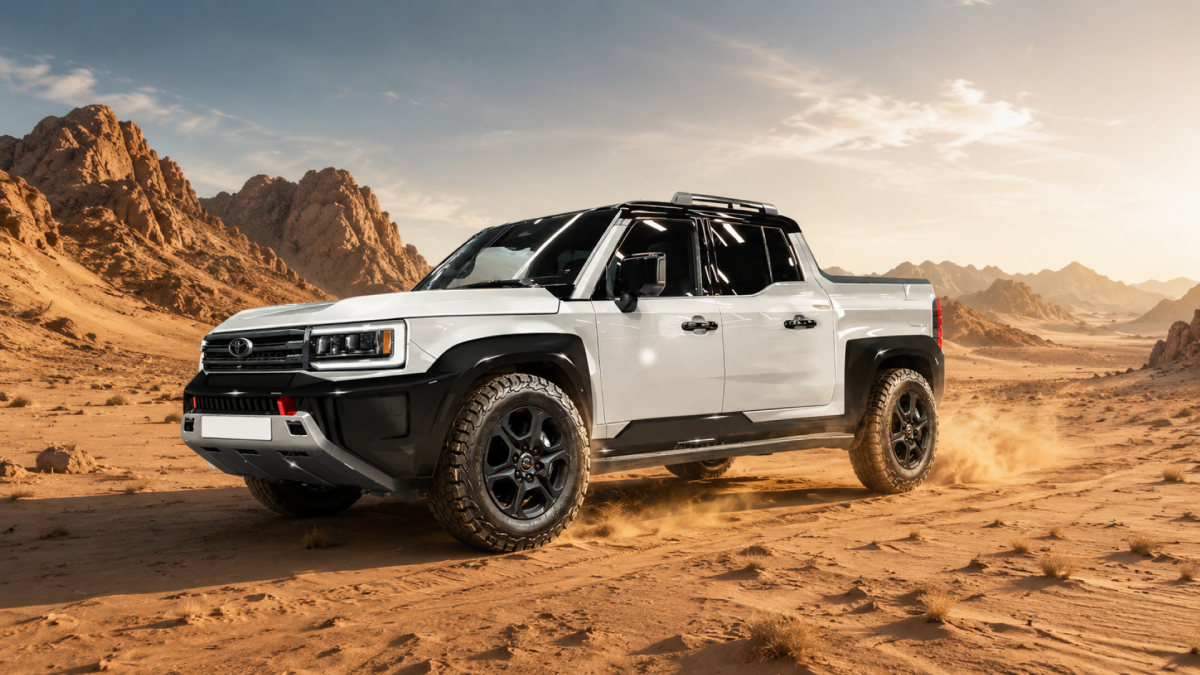
Despite its unibody construction, the 2027 Toyota Stout won’t look soft. Early design concepts and industry renderings suggest Toyota will borrow styling cues from its rugged body-on-frame trucks, creating a distinctive visual identity that sets it apart from crossover competitors.
The 2023 Toyota EPU concept, revealed at the Japan Mobility Show, provides hints about potential design directions. While the production Stout won’t be as futuristic as this concept, expect to see:
- Squared-off, aggressive front fascia with trapezoidal grille elements
- Short front overhang for improved approach angles
- Pronounced fender flares and bold wheel arches
- Integrated LED lighting elements for modern appearance
- Available all-terrain tires and TRD off-road packages
The overall dimensions are expected to measure between 177 and 183 inches in length, placing the Stout squarely in competition with the Ford Maverick and Hyundai Santa Cruz. This compact footprint ensures easy parking and maneuverability in urban environments while providing enough bed space for practical utility.
Interior design will likely prioritize modern technology and comfort over traditional truck ruggedness. Expect a car-like cabin with premium materials, advanced infotainment systems, and the connectivity features today’s buyers demand. Unlike the Tacoma’s utilitarian approach, the Stout will emphasize refined daily drivability.
Capability and Utility: Real Truck Credentials
The Toyota Stout release date matters because this truck promises genuine utility despite its compact dimensions. While not designed for heavy-duty work applications, the Stout will deliver sufficient capability for its target market of urban commuters, small business owners, and weekend adventurers.
Expected capability specifications include:
- Towing capacity: 2,000 to 3,500 pounds depending on configuration
- Payload capacity: approximately 1,500 pounds
- Bed features: integrated tie-downs, available bed lighting, and clever storage solutions
- All-wheel drive: optional for enhanced traction and light off-road capability
These numbers won’t match the Tacoma or Tundra, but they represent exactly what most compact truck buyers actually need. The Stout will handle small trailers, recreational gear, and DIY project materials with ease, while remaining far more manageable for daily driving than larger alternatives.
The TRD off-road package, if offered, would add enhanced suspension, all-terrain tires, and additional drive modes for buyers seeking more adventurous capability. This would position the Stout as a versatile lifestyle vehicle ready for camping trips, mountain bike excursions, and light trail exploration.
Pricing Strategy: Competitive Positioning for the Mass Market
Pricing represents a critical factor for the Toyota Stout release date and its market success. Industry analysts expect Toyota to target a starting price around $30,000, positioning the Stout competitively against the Ford Maverick while undercutting the larger Tacoma’s $33,000+ entry point.
The pricing structure will likely follow Toyota’s established trim hierarchy:
Table
| Trim Level | Expected Price Range | Key Features |
|---|---|---|
| Base/LE | ~$30,000 | Hybrid powertrain, front-wheel drive, essential features |
| Mid/SE | ~$34,000 | All-wheel drive, upgraded infotainment, comfort enhancements |
| Premium/XLE | ~$38,000 | Leather seating, premium audio, advanced safety features |
| TRD Off-Road | ~$42,000 | Enhanced suspension, all-terrain tires, off-road drive modes |
| Limited/Platinum | ~$45,000 | Full luxury appointments, PHEV option, maximum technology |
This pricing strategy makes the Stout accessible to first-time truck buyers, young families, and urban dwellers who need occasional utility without committing to a larger, more expensive vehicle. Toyota’s strong resale value reputation further enhances the value proposition, making the Stout an intelligent long-term investment.
Technology and Safety Features
When the Toyota Stout release date arrives, buyers can expect a comprehensive technology package that rivals Toyota’s latest crossover offerings. The infotainment system will likely feature a large touchscreen display—potentially up to 14 inches on higher trims—with wireless Apple CarPlay and Android Auto compatibility, over-the-air update capability, and cloud-based navigation.
The digital instrument cluster, available in 7-inch or 12.3-inch configurations, will provide customizable information displays including hybrid system monitors, all-wheel drive torque distribution, and fuel economy data. Available premium features may include:
- Wireless phone charging
- Head-up display with navigation and hybrid system information
- Digital rearview mirror with integrated HomeLink
- JBL premium audio system
- Heated and ventilated seats with power adjustment
Safety technology will center on Toyota Safety Sense 3.0, the company’s latest advanced driver assistance suite. Expected features include Pre-Collision System with Pedestrian Detection, Dynamic Radar Cruise Control, Lane Departure Alert with Steering Assist, Automatic High Beams, and Proactive Driving Assist. These systems provide comprehensive protection while reducing driver fatigue during daily commutes.
Market Competition: How the Stout Stacks Up
The Toyota Stout release date positions it to enter a competitive landscape currently dominated by the Ford Maverick, with the Hyundai Santa Cruz representing the only other significant player. However, market dynamics are shifting, with reports suggesting the Santa Cruz may discontinue U.S. sales by 2027, potentially leaving the segment more open for Toyota’s entry.
Ford Maverick advantages include:
- Established market presence since 2021
- Proven hybrid powertrain with 37 MPG combined
- Strong sales momentum (over 155,000 units in 2025)
Toyota Stout competitive advantages:
- Toyota’s legendary reliability reputation
- Potentially more powerful PHEV option
- TRD off-road credibility
- Stronger resale value history
The Stout’s success will depend on Toyota’s ability to match or exceed the Maverick’s value proposition while leveraging its brand strengths in quality and durability. With the compact truck segment growing and potentially losing the Santa Cruz, the timing for the Toyota Stout release date could prove strategically advantageous.
Global Market Strategy: Beyond North America
While much attention focuses on the U.S. market Toyota Stout release date, Toyota is simultaneously developing compact pickup variants for other global markets. Brazil has emerged as a key market, with Toyota reportedly planning a Corolla Cross-based pickup debuting in early 2027 with gasoline, hybrid, and flex-fuel PHEV options.
This Brazilian model will compete against the Fiat Toro, Ram Rampage, and Chevrolet Montana in a rapidly growing South American segment. Production at Toyota’s Sorocaba plant represents part of an $11 billion reais ($2.2 billion) investment in Brazilian operations through 2030.
The relationship between this Brazilian model and the U.S.-market Stout remains unclear. Toyota may develop region-specific variants or eventually converge on a single global platform. What is certain is that Toyota views compact pickups as strategically important across multiple markets, increasing confidence that the Toyota Stout release date will deliver a well-developed, thoroughly tested product.
Manufacturing and Production Considerations
The Toyota Stout release date depends partly on manufacturing logistics. For U.S. market success, Toyota must produce the Stout domestically or in NAFTA partner countries to avoid the 25% “Chicken Tax” tariff on imported light trucks. This constraint has shaped speculation about potential production locations.
Toyota’s extensive North American manufacturing network includes facilities in Kentucky, Indiana, Texas, and Mississippi, any of which could potentially accommodate Stout production. The specific plant will depend on platform sharing arrangements, existing capacity, and supply chain optimization.
Some reports have suggested Toyota Motor Manufacturing Mississippi as a potential Stout production site, though these remain unconfirmed. Regardless of location, domestic production will be essential for competitive pricing and market viability.
What the Toyota Stout Release Date Means for Truck Buyers
The arrival of the Toyota Stout release date represents more than just another new vehicle launch—it signals a fundamental shift in how major manufacturers view the compact truck segment. Toyota’s entry validates the category’s long-term viability and will likely accelerate competition and innovation.
For consumers, the Stout offers:
- Lower entry price into truck ownership
- Superior fuel efficiency compared to mid-size and full-size alternatives
- Easier daily drivability with car-like handling and maneuverability
- Sufficient capability for typical weekend and light-duty needs
- Toyota reliability and strong resale value
The Stout also provides a logical entry point into Toyota’s truck ecosystem, potentially converting sedan and crossover buyers who might eventually upgrade to Tacoma or Tundra models as their needs evolve.
Final Thoughts: Is the 2027 Toyota Stout Worth the Wait?
As the Toyota Stout release date approaches, anticipation continues building among truck enthusiasts and practical buyers alike. While Toyota has not officially confirmed every detail, the convergence of executive statements, trademark filings, platform development, and market conditions creates compelling evidence that this compact pickup will become reality.
The Stout represents Toyota’s recognition that not every truck buyer needs—or wants—the size, cost, and fuel consumption of larger pickups. By combining hybrid efficiency, genuine utility, modern technology, and Toyota’s reputation for quality in a right-sized package, the revived Stout could redefine expectations for what a compact truck can deliver.
For buyers considering the Ford Maverick or awaiting alternatives to larger trucks, monitoring the Toyota Stout release date developments makes perfect sense. When it finally arrives, this historic nameplate’s return could mark the beginning of a new era in accessible, efficient, and genuinely useful compact pickups.
Stay tuned for official announcements as the Toyota Stout release date draws closer. Based on everything we know, this is one truck launch that promises to be worth the wait.
Are you excited about the Toyota Stout? Share your thoughts in the comments below, and subscribe for the latest updates on the Toyota Stout release date and other automotive news.