
Meta Description: Discover the official 2027 Toyota Camry release date, pricing, hybrid specs, fuel economy, and trim levels. Get the latest updates on America’s favorite midsize sedan.
Introduction: The Camry Legacy Continues
The 2027 Toyota Camry release date is one of the most anticipated announcements in the automotive world, and for good reason. As America’s best-selling sedan for over two decades, the Toyota Camry has consistently delivered the perfect blend of reliability, efficiency, and value that millions of drivers trust for their daily commute. With the automotive industry rapidly shifting toward electrification, the 2027 Camry arrives at a pivotal moment—exclusively hybrid, more technologically advanced than ever, and ready to prove that the traditional family sedan is far from dead.
Toyota’s decision to make the Camry hybrid-only starting with the 2025 model year was a bold move that paid off handsomely. Now, as we approach the 2027 Toyota Camry release date, expectations are high for incremental improvements that refine an already impressive formula. Whether you’re a loyal Camry owner looking to upgrade or a first-time buyer considering your options, this comprehensive guide covers everything from release timing and pricing to performance specs and advanced safety features.
When is the 2027 Toyota Camry Release Date?
Based on Toyota’s traditional product cycle and industry reports, the 2027 Toyota Camry release date is expected to fall in August 2026, with vehicles arriving at dealerships shortly thereafter. This timing follows Toyota’s established pattern of introducing new model year vehicles in late summer or early fall of the preceding year. Some sources suggest a late 2026 arrival, giving potential buyers ample opportunity to experience the latest iteration before the end of the calendar year.
The 2027 model represents a carryover year following the comprehensive ninth-generation redesign that debuted for 2025. While major architectural changes aren’t expected, Toyota typically uses these mid-cycle periods to introduce subtle refinements, technology updates, and potential new color options. For buyers asking “when does the 2027 Toyota Camry come out?” the answer is clear: mark your calendars for late summer 2026, with full availability by early fall.
2027 Toyota Camry Price and Trim Levels
Pricing for the 2027 Toyota Camry is expected to see a modest increase over the 2026 model, reflecting inflationary pressures and enhanced standard equipment. Industry estimates place the starting MSRP at approximately $31,200 for the base LE trim, representing roughly a 1-3% increase year-over-year—a typical adjustment for new model years in this segment.
The 2027 Camry will continue to offer five distinct trim levels, each available with either front-wheel drive or electronic on-demand all-wheel drive:
| Trim | Estimated Starting MSRP (FWD) | Key Features |
|---|---|---|
| LE | ~$31,000 | 16-inch alloy wheels, 8-inch touchscreen, Toyota Safety Sense 3.0, dual-zone climate control |
| SE | ~$33,500 | Sport-tuned suspension, 18-inch black wheels, SofTex upholstery, paddle shifters |
| Nightshade | ~$33,100 | 19-inch satin black wheels, gloss-black exterior accents, black badging |
| XLE | ~$37,000 | 12.3-inch digital gauge cluster, 12.3-inch touchscreen, leather seating, ambient lighting |
| XSE | ~$38,200 | Sport mesh grille, 19-inch wheels, premium JBL audio, head-up display |
All-wheel drive adds approximately $1,525 to any trim level. Fully loaded XSE AWD models with optional packages can push past $43,000, a figure that would have seemed remarkable for a Camry a decade ago but now reflects the segment’s upward trajectory in technology and content.
Hybrid Powertrain: Efficiency Meets Performance
The 2027 Toyota Camry remains exclusively hybrid, a strategy that has distinguished it from competitors like the Honda Accord, which continues to offer non-hybrid powertrains. Every Camry utilizes Toyota’s proven 2.5-liter Atkinson-cycle four-cylinder engine paired with the fifth-generation Toyota Hybrid System (THS 5).
Front-wheel-drive models produce a combined 225 horsepower from the gasoline engine and two electric motors. All-wheel-drive variants add a third electric motor powering the rear axle, boosting output to 232 horsepower. This electronic on-demand AWD system operates seamlessly, engaging the rear wheels automatically when additional traction is needed without the mechanical complexity or efficiency penalties of traditional AWD systems.
The continuously variable transmission (eCVT) has been tuned to deliver more natural acceleration feel, addressing earlier criticisms of “rubber band” throttle response. In real-world testing, the Camry XSE AWD achieves 0-60 mph in 6.8 seconds—competitive with the Honda Accord Hybrid’s 6.7-second sprint—while delivering far superior fuel economy.
Fuel Economy: Setting the Segment Standard
Fuel efficiency remains the 2027 Toyota Camry’s most compelling selling proposition. EPA estimates are expected to carry over from the 2026 model, with the base LE front-wheel-drive achieving an extraordinary 52 mpg city, 49 mpg highway, and 51 mpg combined. These figures place the Camry in the same efficiency conversation as the smaller Toyota Prius, despite offering significantly more interior space and comfort.
Upper trims with larger wheels and AWD see modest efficiency reductions but remain impressive:
- LE AWD: 50 mpg city / 49 highway / 50 combined
- SE/XLE/XSE FWD: 47 city / 45 highway / 46 combined
- SE/XLE AWD: 46 city / 46 highway / 46 combined
- XSE AWD: 43 city / 43 highway / 43 combined
Real-world highway testing by automotive publications has validated these claims, with an XSE AWD returning 43 mpg at a steady 75 mph—matching its EPA highway estimate. For comparison, the Honda Accord Hybrid Touring managed only 36 mpg in identical testing, highlighting the Camry’s efficiency advantage.
Exterior Design: Sleeker and More Sophisticated
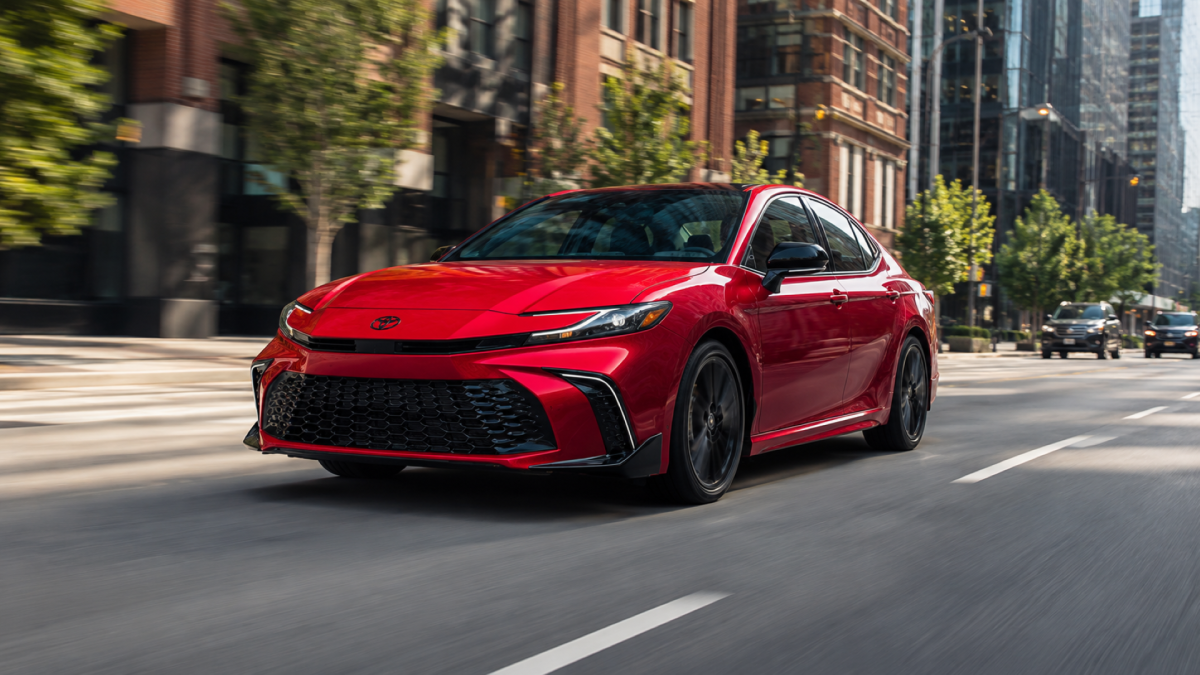
While the 2027 Camry carries over the ninth-generation’s fundamental architecture, Toyota continues to refine its exterior presence. The current design language features a distinctive “hammerhead” front fascia with C-shaped LED daytime running lights, a thin upper grille, and a large lower air intake that gives the sedan a more aggressive stance than previous generations.
The Nightshade Edition remains a popular choice for buyers seeking sporty aesthetics without the XSE’s price premium. It features 19-inch satin black alloy wheels, gloss-black door handles, mirror caps, rear spoiler, and badging—available in Ice Cap, Supersonic Red, and Midnight Black Metallic. For 2027, Toyota may introduce additional exterior color options, potentially expanding the two-tone palette currently offered on XSE models with contrasting Midnight Black Metallic roofs.
Sharp character lines along the flanks and a fastback-inspired roofline contribute to a drag coefficient that helps enable the Camry’s exceptional fuel economy. The design successfully balances visual presence with aerodynamic efficiency, proving that practicality doesn’t require bland styling.
Interior Comfort and Technology
Inside, the 2027 Toyota Camry continues to prioritize usability over gimmickry—a refreshing approach in an era of overwhelming touchscreen integration. Toyota commendably retains physical buttons for climate controls, allowing drivers to make adjustments without diverting attention from the road.
Standard technology includes:
- 8.0-inch touchscreen infotainment system
- Wireless Apple CarPlay and Android Auto
- 7-inch digital instrument cluster
- Five USB ports (front and rear)
- Qi wireless charging pad
Available upgrades on XLE and XSE trims include:
- 12.3-inch touchscreen with Toyota’s latest interface
- 12.3-inch fully digital gauge cluster
- 10-inch head-up display
- 9-speaker JBL premium audio system
- Over-the-air software update capability
The cabin offers generous space for five adults, with 42.1 inches of front legroom and 38.0 inches of rear legroom. While rear headroom can be tight for taller passengers, the overall packaging remains competitive within the midsize segment. Cargo capacity stands at 15 cubic feet—sufficient for seven carry-on suitcases according to independent testing—with split-folding rear seats expanding utility for larger items.
Advanced Safety Features
Every 2027 Toyota Camry comes standard with Toyota Safety Sense 3.0 (TSS 3.0), a comprehensive suite of driver-assistance technologies that includes:
- Pre-Collision System with Pedestrian and Cyclist Detection
- Full-Speed Range Dynamic Radar Cruise Control
- Lane Departure Alert with Steering Assist
- Lane Tracing Assist
- Road Sign Assist
- Automatic High Beams
- Proactive Driving Assist (gentle braking into curves)
Additional available features include Blind Spot Monitor with Rear Cross-Traffic Alert, front cross-traffic alert, lane change assist, and a 360-degree panoramic view monitor. These technologies have helped the Camry earn top crash-test ratings from both NHTSA and IIHS, reinforcing its reputation as a safe family vehicle.
Driving Dynamics and Real-World Performance
Behind the wheel, the 2027 Toyota Camry delivers exactly what its target audience seeks: comfortable, predictable, and efficient transportation. The hybrid powertrain’s instant electric torque provides responsive acceleration from stoplights, while highway merging requires minimal effort despite the modest horsepower figures.
The SE, XSE, and Nightshade trims receive sport-tuned suspensions with firmer damping and quicker steering ratios, offering slightly more engaging handling without compromising the ride quality that Camry buyers expect. However, enthusiasts should note that steering feedback remains light and emotionally detached—this is not a sports sedan, nor does it pretend to be.
At highway speeds, the Camry settles into a calm, long-distance cruiser persona. Road and wind noise are well suppressed, especially in XLE models with acoustic-laminated front glass. Seat comfort remains excellent even after several hours of driving, making the Camry an ideal choice for sales professionals, rideshare drivers, and anyone who spends significant time on the road.
Warranty and Ownership Costs
Toyota backs the 2027 Camry with competitive warranty coverage that reflects confidence in its hybrid technology:
- Limited Warranty: 3 years / 36,000 miles
- Powertrain Warranty: 5 years / 60,000 miles
- Hybrid Component Warranty: 10 years / 150,000 miles
- Complimentary Maintenance: 2 years / 25,000 miles
The hybrid battery warranty is particularly noteworthy, offering peace of mind for buyers concerned about long-term replacement costs. Toyota’s industry-leading resale value—bolstered by the Camry’s reputation for reliability—further reduces total cost of ownership. According to depreciation analyses, the Camry retains approximately 65% of its value after five years, outperforming the average sedan by a significant margin.
How the 2027 Camry Compares to Competitors
In the shrinking midsize sedan segment, the 2027 Toyota Camry faces primary competition from the Honda Accord, Hyundai Sonata, and Kia K5. Against the Accord, the Camry’s advantages include standard hybrid powertrain (versus the Accord’s optional hybrid), available all-wheel drive (unavailable on Accord), and superior real-world fuel economy. The Accord counters with slightly more rear legroom and a more engaging driving character.
The Hyundai Sonata and Kia K5 offer distinctive styling and competitive pricing but lack the Camry’s hybrid efficiency and all-wheel-drive availability. For buyers prioritizing long-term reliability and resale value—historically the Camry’s strongest attributes—Toyota’s offering remains the rational choice.
Should You Wait for the 2027 Toyota Camry?
For prospective buyers currently driving older vehicles, waiting for the 2027 Toyota Camry release date makes sense if you value the latest technology and potential minor refinements. However, given that the 2027 model is a carryover year with no significant changes planned, purchasing a discounted 2026 model once the 2027 arrives could yield substantial savings.
If you’re specifically interested in the Nightshade Edition’s blacked-out aesthetics or want the most up-to-date software capabilities, the 2027 model warrants the wait. Otherwise, the fundamentally identical 2026 Camry may offer better value as dealerships clear inventory.
Final Verdict: The Rational Choice
The 2027 Toyota Camry doesn’t attempt to reinvent the midsize sedan—it simply perfects the formula that has made it America’s favorite car for generations. With its August 2026 release date approaching, buyers can expect a vehicle that delivers exceptional fuel economy, proven hybrid reliability, comprehensive safety technology, and the peace of mind that comes with Toyota’s legendary quality.
In an automotive landscape increasingly dominated by oversized SUVs and complex electric vehicles, the Camry remains a beacon of rational transportation. It starts every morning, sips fuel like a subcompact, accommodates families in comfort, and holds its value better than nearly any competitor. Sometimes, “boring” is exactly what real-world drivers need—and the 2027 Camry executes this mission flawlessly.